1. Services
  2. Systems
  3. Process
  4. Results
  5. Guides
  6. Academy
  7. Questions
  8. Book a consultation
+91 77382 65345 WhatsApp English · हिन्दी · ગુજરાતી · मराठी

Non-surgical hair replacement in Andheri East, Mumbai

4.9

Hair you never have to explain.

A hair system made on a template of your own head, cut onto you in a private room. Built to survive daylight and close conversation — not just a photograph.

  • Free consultation No charge to come in, and nothing to buy on the day.
  • EMI available Ask us and we'll take you through the options.
Studio since 2016 Custom systems for men and women Appointments only — one client at a time

Measured, tied, fitted and cut — in one private room.

A bare base mesh, a coil of dark hair, folded strips of tape and a small bottle of bonding liquid, laid out in a row.
A fine steel hook drawing a single hair through transparent lace mesh, caught mid-knot.
A hair system being lowered onto a blank display head, hands pressing the front edge down.
Barber scissors point-cutting into dark hair on a head seen from behind.

The work is invisible. That is the entire job.

A hair system is not a wig and it is not a haircut. It is a piece of hand-tied craft, made on a template of your own head, and it either disappears or it doesn't. Everything we do — the base we choose, the density we tie, the way the front hairline is graded — exists to make it disappear.

How a patch is made,
and how it goes on.

Four photographs. What the thing actually is, how it is built, how it is held on, and the step that decides whether anybody notices.

  1. A bare base mesh, a coil of dark human hair, folded strips of medical tape and a small bottle of bonding liquid, laid out separately.
    • The base
    • The hair
    • Tape
    • Bonding

    What a system is made of

    A base, the hair that is tied into it, and what holds it to your head. The base in this photograph is empty — every hair goes in afterwards, by hand.

  2. Extreme close-up of a fine steel hook drawing a single hair through transparent lace mesh, caught mid-knot.
    • One knot
    • Mesh still empty

    Tied by hand, one hair at a time

    Each strand is knotted into the mesh at an angle, so it falls the way your own hair falls. Get the angle wrong and it stands up instead. Two to three weeks to build one.

  3. A hair system being lowered onto a matte display head, hands pressing the front edge down, tape visible where the edge meets the scalp.
    • Tape at the edge

    It goes on. Nothing goes in

    Held at the edge with medical-grade tape or liquid bonding. No surgery, no injections, nothing under the skin. It stays on through the shower, the gym and the rain, and comes off when we take it off.

  4. Barber scissors point-cutting into dark hair already fitted on a head, a few cut fragments suspended in the light.
    • Point-cut, not straight across

    Cut on your head, never on a block

    The same system, cut well or cut badly, is the difference between nobody noticing and everybody noticing. This is the step where it stops being an object and starts being your hair.

An illustration. Not a client.

Almost nobody we work with wants their face on a website, and that is the entire point of the work — so we have not put one here. This pair is computer-generated: one face, one light, one lens, and a hairline built the way we build them. Set slightly high, deliberately irregular, density a shade under what a man his age would carry. Drag the divider and watch the front edge. That is where a bad system gives itself away.

Before — head and shoulders, straight on, neutral expression, even light. 4:5 portrait.
After — identical camera, light and framing. Only the hair differs. 4:5 portrait.
Before After Computer-generated illustration · not a client

Drag the divider, or use the arrow keys.

Work we're allowed to show.

Most of what we do never appears anywhere, and that is the arrangement most men want. These are the pieces whose owners told us, in writing, that we could.

  • Before — scalp
    Before Thinning crown
    After — fitted
    After Covered and cut in
  • Before — scalp
    Before Receding front
    After — fitted
    After Front edge rebuilt
  • Before — scalp
    Before Diffuse thinning
    After — fitted
    After Density restored
  • Before — scalp
    Before Receding temples
    After — fitted
    After Hairline brought forward

From first call to walking out.

Roughly two to three weeks for a fully custom system, or same-week if a ready base suits you. You'll know which after the consultation.

  1. Private consultation

    One client in the studio at a time. We look at the scalp, discuss what you want back, and set expectations honestly.

  2. Template and match

    Mould, hairline drawing, colour and density match against your own hair in daylight.

  3. Build

    The system is hand-tied to your specification.

  4. Fitting and cut

    Attached, then cut and blended into your existing hair while it's on your head. This is where it becomes yours.

  5. Living with it

    We show you washing, styling and what to do at the gym, on a beach and in monsoon before you leave.

  6. Maintenance

    Refit every three to four weeks — clean, re-bond, re-trim. Twenty minutes, booked ahead.

The detail people shouldn't notice.

The front edge, the parting and the crown — the three places people look, at the distance a colleague actually stands from you. Illustrations, not photographs of clients: we don't publish anyone's head without their written permission.

Macro — front edge against forehead skin, hair swept up and back.
The front edge, with hair pushed back off the face.
Macro — parting, showing knots and scalp through the base.
A parting, showing scalp through the base.
Macro — crown whorl, direction of fall.
The crown, where the hair changes direction.

Where the knot sits is
the whole difference.

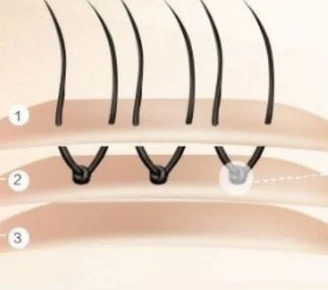
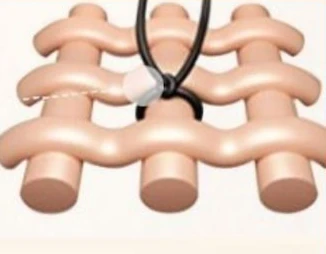
Two patches can hold the same hair and look nothing alike at a parting. What separates them is not the hair — it is how each strand is tied in, and whether you can see the knot.

Cutaway of a single lace base: one hair knotted around a strand of the open mesh, the knot sitting on the upper surface.

Ordinary lace base

Hand-knotted straight into the mesh

The knot
Tied directly into the lace, so it sits on the surface.
At the parting
Knots are visible close up unless they are bleached or tinted.
Breathability
Better. Open mesh, nothing sealing it — which matters in Mumbai.
Weight
Lighter on the head.
Suits
A natural front hairline, and heat.
Cutaway of a silk top in three layers: hair emerging from the top layer, the knots trapped in the layer beneath, and a backing layer below that.

Silk top — the “Miraj” type

Knots hidden between two layers

The knot
Each hair is drawn through lace and silk, trapping the knot between them.
At the parting
No knot visible from any angle. The parting reads as scalp.
Breathability
Less. The extra layer is what hides the knot.
Weight
Slightly thicker to the touch.
Suits
A visible parting, and anyone worried about close inspection.

Ask what you are actually being sold. “Miraj” — also spelled Mirage — is a name the Indian market uses for several different builds, not a single specification. Two shops can quote it for two different bases. Ask what the base is made of, where the knots sit and what the border is, and compare those rather than the name.

Why people come to us quietly.

Hair loss is a private thing to deal with, and we've built the studio around that rather than around footfall.

  • One client at a time

    Appointment only. You won't sit in a waiting area or be fitted in front of anyone.

  • Technicians, not salespeople

    The person who measures you is the person who ties, fits and cuts. Nobody is on commission.

  • Honest about what it can't do

    If a system is wrong for your pattern of loss or your lifestyle, we'll tell you in the consultation.

  • Maintenance is the service

    Fitting one system is easy. Keeping it looking right, month after month, is the actual work.

  • English, हिन्दी, ગુજરાતી, मराठी

    Consultations run in whichever language you're most comfortable being frank in.

  • Built for this climate

    Mumbai humidity, monsoon and sweat break weak bonds. Materials are chosen against that, not a catalogue.

  • Human hair only

    Remy, cuticle-aligned. It costs more and it's the reason it still looks right in month six.

  • Nothing shared

    Your photographs stay in the studio unless you specifically ask us to use them.

In their words.

Reviews from our Google profile, copied word for word. Nothing here is edited or invented, and the photographs policy has not changed — no client's face appears on this site.

4.9 from 34 Google reviews — read them all

  • ★★★★★

    I recently got my hair patch fixed here, and I am extremely satisfied with their service. The staff is very professional…
    Jomzz Mathew Google review
  • ★★★★★

    Mera experience Bombay Hair Patch ke sath bohot hi kamaal ka raha Yahan aane se pehle main thoda nervous tha, lekin inki…
    Sk maruf Ali Google review
  • ★★★★★

    Bombay Hair Patch में मेरा अनुभव शानदार रहा। स्टाफ बहुत प्रोफेशनल, विनम्र और मददगार है। उन्होंने पूरी प्रक्रिया को अच्छे…
    ASRAF Mallick Google review
  • ★★★★★

    Best hair patch services , very happy , must try once to check if you really getting the best at your current one
    Datta Chavan Google review
  • ★★★★★

    I, Mr. Pranay Sawant, am a genuine and satisfied customer of Bombay Hair Patch and Ali Bhai for the last 3 years. …
    Pranay Sawant Google review

Tap a card to stop it and read the whole review. Tap again to let it go.

Wear it and forget it.

With a bonded system it stays on through the shower, the gym and the rain, and comes off when we take it off. Two things on this list shorten the bond, and they are the reason your maintenance interval is set around what you actually do rather than an average.

  • Sleeping — back of the head on a pillow, low lamp light. No face.

    Sleep

    It stays on. You do not take it off at night.

  • Showering — water running through hair, seen from behind. No face.

    Shower

    You wash your hair normally.

  • Gym — a man mid-set, seen from behind or in profile turned away.

    The gym

    It holds. Heavy sweat shortens the bond, so we set your interval around it.

  • Running outdoors, from behind, hair moving. No face.

    Running

    Hair moves the way it should, because it is tied to fall that way.

  • Monsoon — walking in heavy rain, from behind, wet hair. No face.

    Monsoon

    Mumbai humidity and rain break weak bonds. Yours is chosen against that.

  • Swimming — surfacing in a pool, seen from behind. No face.

    Swimming

    Yes. Salt water and chlorine shorten the bond, so swim daily and you will refit more often.

The questions everybody asks and nobody wants to ask out loud.

If yours isn't here, message us on WhatsApp. You don't have to give your name.

Will people be able to tell?
At conversation distance, no — assuming the density, colour and hairline are right, which is what the consultation is for. Up close and under direct light, a well-made system on a properly prepared scalp still holds up; a badly matched one doesn't. The giveaways are almost always too much hair, too dark a colour and a hairline that's too low and too straight, not the material itself.
Can I shower, swim and go to the gym?
Yes, with a bonded system. You wash your hair normally. Salt water, chlorine and heavy sweat shorten the bond, so if you swim daily you'll come in for a refit more often. We'll set your maintenance interval around what you actually do rather than an average.
Does it damage the hair I still have?
Properly applied and properly removed, no. Damage comes from pulling systems off dry, leaving bonds on far past their interval, and aggressive adhesives on an irritated scalp. That's the argument for coming back for maintenance rather than managing it yourself.
How long does one system last?
Depends on base and wear. A thin poly or lace front is the most natural and the least durable; a thicker base lasts longer and reads slightly less fine at the hairline. Most clients run two systems in rotation so one is always fresh. We'll give you a realistic number for your specific build at the consultation rather than a headline figure here.
How often do I need to come in?
Every three to four weeks for a clean, re-bond and trim. It's about twenty minutes. Skipping it is the main reason a good system starts looking like a bad one.
Is it painful, and is anything surgical?
Nothing is surgical, there are no injections and no anaesthetic. The system sits on the scalp and is held with tape or adhesive. The only sensation is the adhesive removal, which is done with a solvent, not force.
Do you do this for women?
Yes — toppers and volumisers for diffuse thinning, and extensions for length and density. The construction principles are the same: match the parting, match the density, hide the edge.
Do I need to shave my head?
No. The system is fitted over the area we're covering and blended into the hair you still have — that remaining hair is what the edges disappear into, so we want it. What we do need is the area under the base kept short and clean, and we trim that for you at each maintenance visit.
What does it cost?
It varies with base material, hair grade and how much area we're covering, and quoting a number without seeing your scalp would be dishonest. Bring your questions to the consultation and you'll get a full figure including the first year of maintenance, in writing, before you commit to anything. EMI is available — ask us and we'll take you through the options. The consultation itself is free.

Your privacy is the product.

Hair loss is a private thing to deal with. Everything below is how the studio is actually run, not a policy page written after the fact.

One client in the studio at a time

Appointment only. You will not sit in a waiting area, and you will not be fitted in front of anyone.

Your photographs stay in the studio

We photograph work for our own reference. Nothing is published unless you specifically ask us to use it, in writing. Most clients never do, which is why there is no wall of faces on this site.

One number, and no list

We reply from a single number. You are not added to a mailing list and your details are not sold, rented or shared.

You do not have to give a name

If you would rather ask everything before identifying yourself, message us and do exactly that. Nobody will push you for details you have not offered.

Book a free private consultation.

The consultation is free. Thirty to forty minutes, one client in the studio, and no obligation to buy anything. You'll leave knowing what would suit you, what it would cost and what it would take to keep up.

Call
+91 77382 65345
WhatsApp
Message the studio
Studio
Shop No. A-212, 2nd Floor, Pranik Chambers,
Nr Sakinaka, Andheri East, Mumbai 400072
Get directions
Hours
Mon, Tue, Fri  10am–9pm
Wed, Thu  11am–9:30pm
Sat, Sun  9am–11:30pm
Languages
English, हिन्दी, ગુજરાતી, मराठी

Scan to book

Point your phone camera at the code and the booking form opens. Tell us what you are dealing with and we will call you back.

Reading this on your phone? Use the button — you cannot scan a code on the screen you are holding.

Book free consultation WhatsApp